Downblast Exhaust Fans Built by Metal Craft Spinning
Metal Craft Spinning manufactures downblast exhaust fans and related ventilation equipment for Canada and the United States, supplying HVAC contractors, commercial kitchen builders, industrial facility engineers, and rooftop ventilation specifiers. Our shop produces spun metal housings, fan wheels, and complete assemblies tuned for the airflow and static pressure conditions our customers actually encounter — not catalog approximations.
What Is a Downblast Exhaust Fan
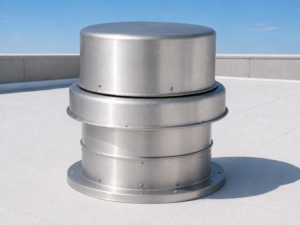
A downblast exhaust fan is a roof-mounted centrifugal exhaust unit that pulls air from inside a building through ductwork and discharges it downward, around the curb base, away from the intake side of the roof. The discharge geometry is the defining feature: instead of pushing exhaust straight up where wind can recirculate it back into rooftop units or fresh-air louvers, the air exits below the fan housing and dissipates across the roof deck.
Downblast fans are among the most common exhaust fan types specified for general building ventilation. They handle clean and lightly contaminated air streams — restrooms, classrooms, office areas, light industrial spaces, and bathroom exhaust risers. For grease-laden kitchen ventilation over commercial cooking lines, an upblast configuration is required by code; downblast fans are not used in that role. The two configurations look similar from the outside but serve different purposes.
A typical downblast unit consists of a spun aluminum or galvanized housing, a backward-inclined or forward-curved centrifugal wheel, a direct-drive or belt-drive motor, a roof curb, and a gravity backdraft damper to prevent reverse airflow when the fan is off. Larger models add birdscreens, disconnect switches, and variable-speed controls.
Manufacturing Capabilities
Metal spinning is a forming process in which a flat metal disc is rotated at high speed against a tool and gradually shaped over a mandrel into a seamless, symmetrical part. For downblast exhaust fan housings, this produces a one-piece spun cap with no welded seams along the airflow path — stronger, smoother, and less prone to leakage than fabricated equivalents.
Our capabilities cover:
- Spinning of aluminum, galvanized steel, stainless steel, and specialty alloys across standard rooftop fan diameters
- Powder coating and corrosion-resistant finishes for coastal and industrial environments
- Short-run and OEM production for distributors and private-label customers
Beyond downblast units, the same shop produces upblast exhaust fans, axial fans, propeller fans, blowers, and replacement wheels. If a project mixes fan types — propeller fans for sidewall ventilation and downblast units on the roof, for example — both can come from one source.
Applications
Downblast exhaust fans are specified across a wide range of buildings.
Specifications and Performance
Selection comes down to matching the fan to the duct system. The two governing numbers are CFM (the volume of air moved, in cubic feet per minute) and static pressure (the resistance the system imposes on that airflow, measured in inches of water column).
Our downblast fans are available across the full range commonly specified in commercial construction:
- Airflow: from a few hundred CFM for small bathroom exhaust risers up to tens of thousands of CFM for industrial and large institutional applications
- Static pressure: sized to overcome the ductwork, dampers, louvers, and filter banks present in real installations
- Wheel speed and tip velocity: selected to balance airflow and acoustic performance — slower, larger wheels run quieter at the same CFM
- Drive options: direct-drive for compact, low-maintenance installations; belt-drive for adjustability and higher static pressure work
- Controls: single-speed, two-speed, and variable-frequency drive compatible
- Backdraft protection: gravity dampers standard, motorized dampers optional where wind-driven backdraft or tight building pressurization is a concern
Each unit is selected against the actual system curve, not just nameplate CFM. A downblast fan rated for 4,000 CFM at 0.25 inches of static pressure will deliver substantially less when duct, damper, and louver losses add up to 0.75. Specifying correctly the first time avoids field rework.
Related Fan Types We Manufacture
Downblast exhaust fans are one piece of a broader ventilation package. Metal Craft Spinning also produces:
- Upblast exhaust fans for grease-laden kitchen exhaust and other applications requiring upward discharge
- Axial fans for high-volume, low-static-pressure applications such as warehouse ventilation
- Centrifugal blowers for ducted systems requiring higher static pressure
- Replacement wheels and components for retrofits and rebuilds
Sourcing multiple fan types from one US-based manufacturer simplifies project logistics and keeps tolerances and finishes consistent across an installation.
Looking for help designing a metal spun part?
Learn key terms and operations to better understand the metal spinning process, machines and tools for metal spinning operation, and common materials used for metal spinning.
Why Choose Metal Craft Spinning
We are a manufacturer, not a reseller. Parts are spun, fabricated and assembled in our own facility, which means we can:
- Quote and produce non-standard sizes without long offshore lead times
- Modify housings on retrofit projects
- Hold tolerances on wheels and housings that translate directly into quieter operation and steadier airflow
- Support OEM and private-label customers with consistent quality across runs
- Build with materials and finishes appropriate to the environment — coastal, industrial, food-service, or standard commercial
Domestic production matters for sustainability and project scheduling. Shorter supply chains mean lower embodied transport emissions and fewer surprises when a job needs replacement parts mid-installation.
Get a Quote
Metal Craft Spinning supplies HVAC distributors, mechanical contractors, OEM partners, and end users directly. Whether the need is a single downblast unit for a bathroom exhaust replacement or a coordinated package of rooftop ventilation equipment for a new build, the shop is set up to deliver.
Why Metal Craft?
With over 60 years of metal spinning experience, we deliver the highest standards of quality throughout our manufacturing process, prioritizing customer satisfaction.
Quality & Experience
With decades of metal spinning expertise, we bring precision and craftsmanship to every project, ensuring consistent, high-quality results.Advanced Manufacturing
Our state-of-the-art equipment streamlines production, delivering high-precision metal components with exceptional accuracy and repeatability.Reliable Partnership
Efficient processes and dedicated support ensure that your components are delivered on time, with careful attention to maintaining quality from our facility to yours.